B.Sc. General - CBZ
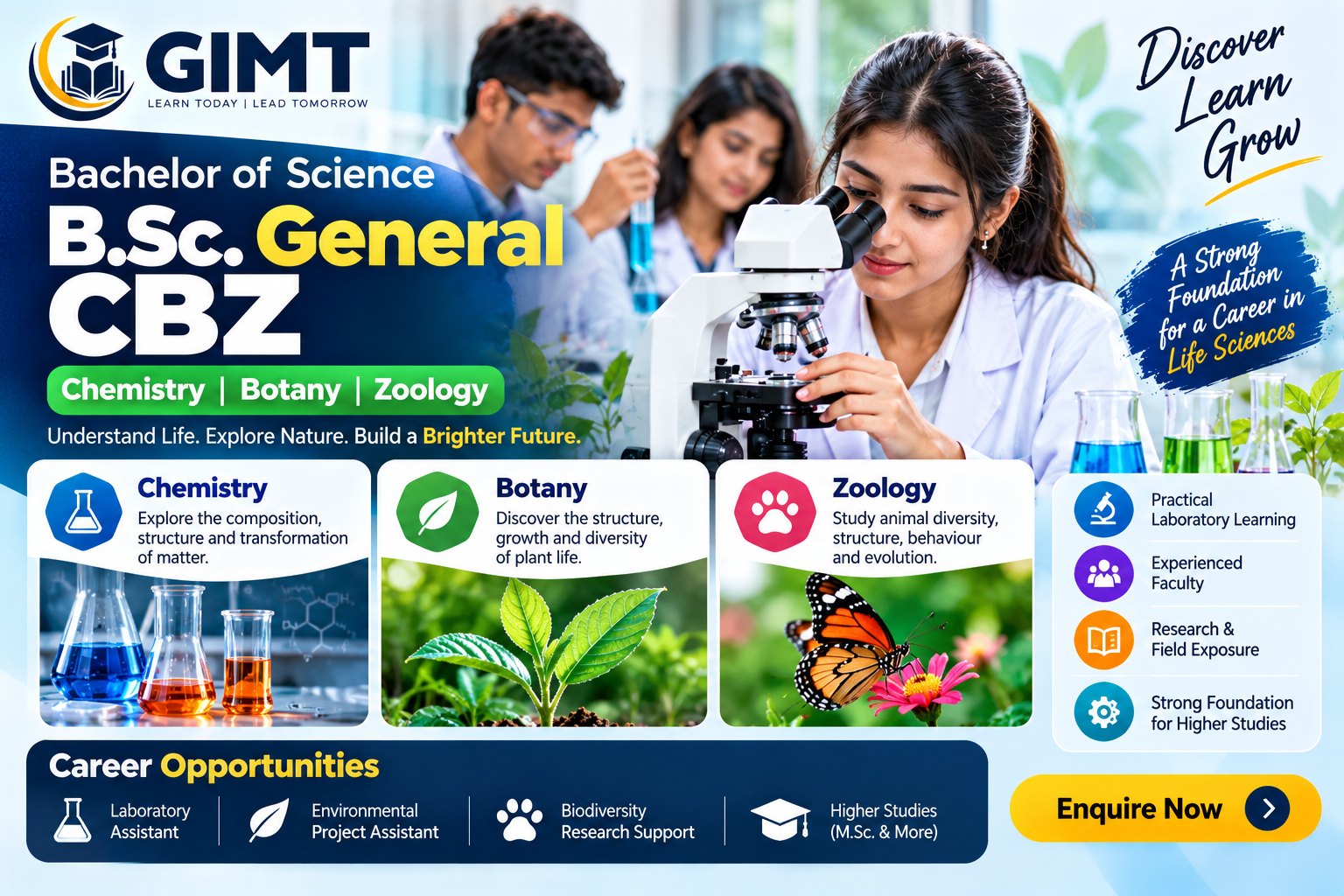
The Bachelor of Science (B.Sc.) General – CBZ is designed for students interested in understanding the natural world through the study of Chemistry, Botany, and Zoology. The programme brings together three complementary scientific disciplines to provide a broad foundation in chemical processes, plant life, animal diversity, and biological systems.
Chemistry introduces students to the composition, properties, structure, and transformations of matter. Botany focuses on plants, their structure, physiology, classification, growth, reproduction, and ecological importance. Zoology explores animals, their anatomy, physiology, behaviour, evolution, diversity, and relationships with their environments.
By studying these subjects together, students can develop a wider understanding of biological processes and the chemical principles that influence living systems. Depending on the approved curriculum, practical learning may include laboratory experiments, specimen observation, microscopy, scientific record-keeping, field studies, and data interpretation.
The programme can provide an academic foundation for students who wish to pursue higher education in science, specialised life-science courses, environmental studies, laboratory-related careers, or research-oriented fields. Career pathways depend on the student's academic performance, practical experience, additional qualifications, and the eligibility requirements of specific employers or institutions.
At GIMT, the published description should reflect the actual approved CBZ subject combination, syllabus, programme duration, and admission requirements.
3. Core Subjects and Learning Areas
Chemistry
Learn about atomic structure, chemical bonding, chemical reactions, acids and bases, organic and inorganic compounds, and the principles of chemical analysis. Practical activities may involve laboratory experiments and chemical testing.
Botany
Explore plant structure, classification, physiology, reproduction, genetics, evolution, and plant ecology. Students may learn about plant diversity, photosynthesis, plant adaptations, and the role of vegetation in ecosystems.
Bacharelado e Licenciatura em Ciências Biológicas | SERVIÇO DE GRADUAÇÃO
Zoology
Study animal diversity, anatomy, physiology, classification, behaviour, evolution, genetics, and ecology. Depending on the syllabus, learning may include specimen observation, animal adaptations, biodiversity, and wildlife conservation.
Note: These are representative subject areas, not a verified semester-wise syllabus for GIMT.
4. Programme Objectives
The B.Sc. General – CBZ programme aims to help students:
- Build foundational knowledge of Chemistry, Botany, and Zoology.
- Understand the structure, function, and diversity of living organisms.
- Develop scientific observation, reasoning, and problem-solving skills.
- Understand chemical and biological processes through theory and practical learning.
- Gain experience in laboratory methods and scientific documentation, where included in the curriculum.
- Develop awareness of biodiversity, environmental conservation, and ecological relationships.
- Prepare for further studies and relevant science-related career pathways.
5. Practical Learning and Skill Development
Depending on the approved curriculum and available facilities, students may gain practical experience through:
- Chemistry experiments and laboratory observations.
- Microscopic examination of plant and biological specimens.
- Plant identification and classification exercises.
- Animal diversity studies and specimen observation.
- Field visits, ecological surveys, and biodiversity studies where prescribed.
- Scientific report writing, data recording, and interpretation.
These activities can help students develop analytical thinking, attention to detail, laboratory discipline, and scientific communication skills.
6. Eligibility Criteria
The usual entry requirement for an undergraduate B.Sc. programme is completion of Class 12 (10+2) or an equivalent qualification from a recognised board, with the required science subjects.
Suggested website wording:
Candidates who have completed Class 12 (10+2) with the required science subjects from a recognised board may apply for the B.Sc. General – CBZ programme, subject to the eligibility criteria and admission regulations prescribed by the relevant university and GIMT.
The exact subject requirements and minimum qualifying marks should be verified with GIMT's official admission rules.
7. Course Duration
The duration of an undergraduate B.Sc. programme depends on the applicable university regulations and programme structure. Some programmes follow a three-year structure, while institutions implementing the four-year undergraduate framework may offer a different duration.
For GIMT: Confirm the officially approved duration, semester structure, and degree-awarding university before publishing a specific duration.
8. Career Opportunities After B.Sc. General – CBZ
The programme can provide a foundation for entry-level opportunities and further study in science-related areas. Specific roles may require additional qualifications, practical experience, or professional training.
Laboratory and Testing
Laboratory Assistant, Sample Processing Assistant, and eligible entry-level roles in chemical or biological testing facilities.
Plant Science and Environment
Plant Research Assistant, Environmental Project Assistant, Biodiversity Survey Assistant, and support roles in ecological projects.
Biological Sciences
Biology Laboratory Assistant, Research Project Assistant, and support roles in relevant life-science organisations, depending on job requirements.
Higher Education
Further study in relevant M.Sc. programmes, specialised life-science courses, environmental science, or other eligible postgraduate programmes.
A general B.Sc. qualification alone does not automatically qualify graduates for regulated healthcare, clinical laboratory, or professional scientific positions. Students should check the specific eligibility requirements for their intended career.
9. Higher Studies After B.Sc. CBZ
Depending on the subjects studied, university admission rules, and any prerequisite credits, graduates may explore:
- M.Sc. Botany.
- M.Sc. Zoology.
- M.Sc. Chemistry.
- M.Sc. Biology or relevant life-science disciplines.
- Postgraduate programmes in environmental science or ecology.
- Other relevant postgraduate programmes and research pathways.
Admission to a particular M.Sc. specialisation is not automatic; the receiving university determines eligibility.
10. Why Consider B.Sc. General – CBZ at GIMT?
When evaluating this programme, prospective students should consider the relevance of the curriculum, faculty qualifications, laboratory facilities, practical teaching, academic support, and opportunities for field-based learning.
GIMT should highlight its verified laboratory resources, teaching approach, student support, and academic facilities on the course page. Claims about research partnerships, placement outcomes, or specialised facilities should be published only when supported by institutional records.
11. Frequently Asked Questions
What does CBZ stand for?
CBZ generally refers to Chemistry, Botany, and Zoology.
Who can study B.Sc. General – CBZ?
Students who meet the institution's Class 12 science-subject and other admission requirements may be eligible.
Does the programme include practical classes?
CBZ programmes commonly include subject-specific practical work, although the exact experiments and practical requirements depend on the approved curriculum.
Can students pursue an M.Sc. after B.Sc. CBZ?
Yes, eligible graduates can apply for relevant postgraduate programmes, subject to the chosen university's subject and admission requirements.
What career options are available after B.Sc. CBZ?
Possible pathways include laboratory support, environmental projects, biological research assistance, and further education in science-related fields.