MSC-(Physics, Chemistry, Mathematics, Biology, Zoology, & Botany)
The Master of Science (M.Sc.) is a postgraduate degree for students who want to deepen their understanding of scientific principles and develop specialised knowledge in a chosen discipline. The programme builds on undergraduate-level learning and introduces more advanced concepts, analytical techniques, subject-specific practical work, and research methodologies.
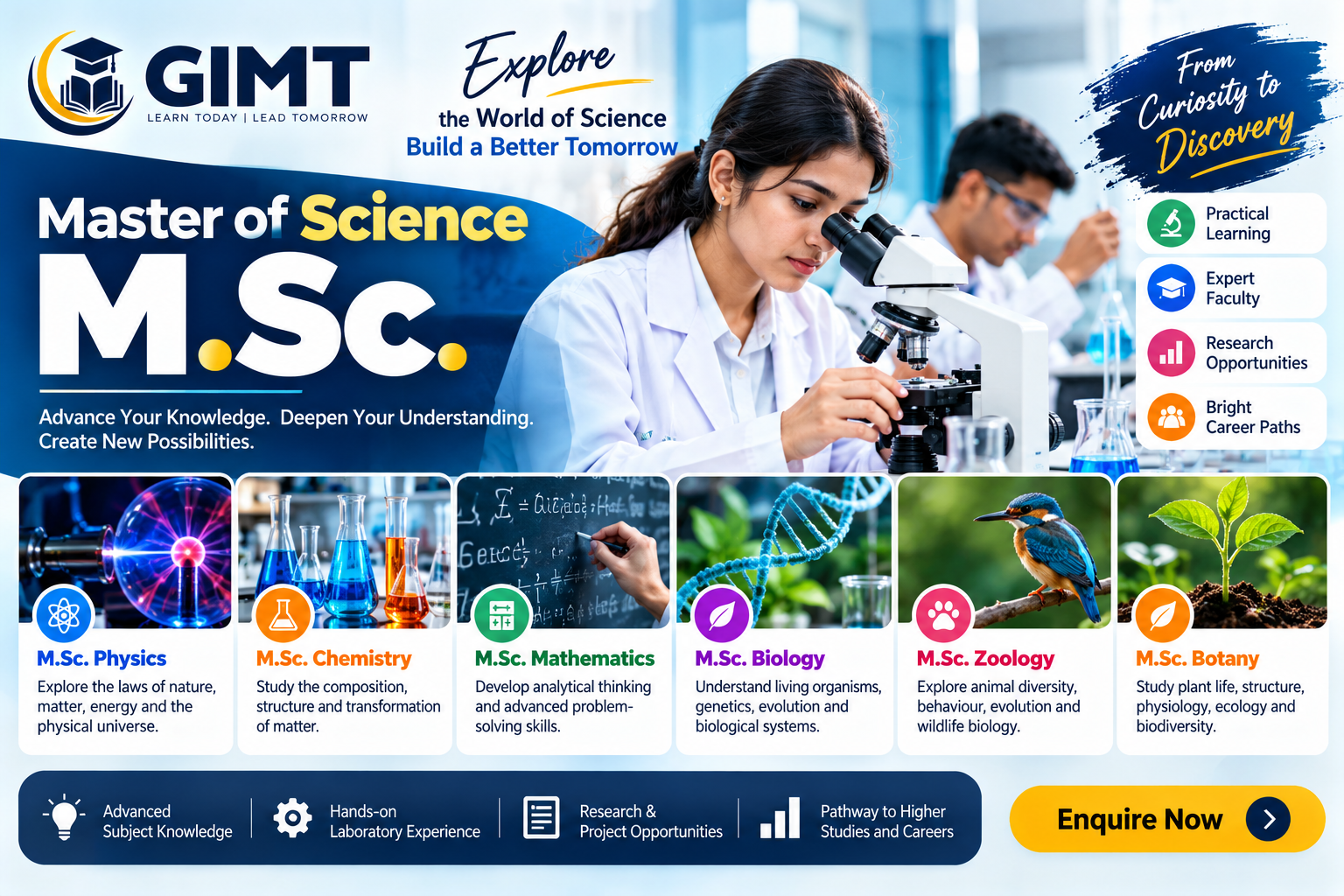
At GIMT, the listed science disciplines include Physics, Chemistry, Mathematics, Biology, Zoology, and Botany. Each discipline offers a different perspective on the natural world, from understanding the fundamental laws of matter and energy to exploring chemical reactions, mathematical structures, living organisms, animal systems, and plant life.
Depending on the approved curriculum, students may undertake laboratory experiments, computational exercises, scientific data analysis, fieldwork, seminars, project work, and research-oriented assignments. These learning activities can help students strengthen their ability to interpret evidence, solve complex problems, communicate scientific findings, and apply disciplinary knowledge to practical challenges.
The programme may be relevant to graduates who wish to pursue scientific research, laboratory-based work, teaching, technical roles, environmental studies, or further postgraduate and doctoral education. Career options depend on the chosen specialisation, practical experience, additional qualifications, and the eligibility criteria for individual positions.
Important: The following subject descriptions explain the typical academic scope of each discipline. GIMT's exact syllabus, course availability, admission requirements, and programme structure should be confirmed against its current official academic records before publication.
3. M.Sc. Specialisations and Subject Details
M.Sc. Physics
Study the fundamental principles governing matter, energy, motion, and the physical universe. Depending on the syllabus, topics may include classical mechanics, quantum mechanics, electromagnetism, thermodynamics, optics, solid-state physics, and modern physics.
Potential career paths: Research Assistant, Laboratory Assistant, Physics Educator (with applicable qualifications), Technical Assistant, and roles in scientific instrumentation.
MSc Analytical Chemistry Full-time 2026 | Sheffield Hallam University
M.Sc. Chemistry
Explore the composition, structure, properties, and transformations of matter. Common areas of study include organic chemistry, inorganic chemistry, physical chemistry, analytical chemistry, spectroscopy, and chemical analysis, depending on the curriculum.
Potential career paths: Chemistry Laboratory Analyst, Quality Control Analyst, Research Assistant, Chemical Testing Professional, and roles in pharmaceutical or chemical industries, subject to job-specific requirements.
Grad Spotlight: Sajjad Ghiasvand | Electrical and Computer Engineering | UC Santa Barbara
M.Sc. Mathematics
Develop advanced mathematical reasoning and quantitative problem-solving abilities. Typical subject areas may include real analysis, abstract algebra, differential equations, topology, numerical analysis, probability, and applied mathematics.
Potential career paths: Mathematics Educator (with applicable qualifications), Quantitative Analyst Trainee, Research Assistant, Data Analyst (with relevant technical skills), and roles involving mathematical modelling.
Medical Bioscience MSc - University of Bradford
M.Sc. Biology
Explore living organisms, cellular processes, genetics, evolution, ecology, and biological diversity. The exact academic scope depends on whether the institution offers a general Biology degree or a specialised life-science programme.
Potential career paths: Biology Research Assistant, Laboratory Research Assistant, Biological Data Assistant, Environmental Project Assistant, and further research or doctoral study.
M.Sc. Zoology
Study animal diversity, structure, physiology, behaviour, evolution, genetics, ecology, and wildlife biology. Depending on the curriculum, students may explore animal classification, developmental biology, conservation, and research methods.
Potential career paths: Zoology Research Assistant, Wildlife Project Assistant, Biodiversity Survey Assistant, Laboratory Research Assistant, and roles in conservation projects, subject to required qualifications.
Laboratoire de Recherche en Sciences Végétales | CNRS Images
M.Sc. Botany
Develop an understanding of plant structure, physiology, taxonomy, genetics, ecology, evolution, and plant diversity. Depending on the syllabus, learning may also cover plant biotechnology, plant pathology, and environmental conservation.
Potential career paths: Botanical Research Assistant, Plant Science Laboratory Assistant, Biodiversity Project Assistant, Environmental Research Assistant, and roles in plant science or agricultural research, subject to specific requirements.
4. Programme Objectives
The M.Sc. programme aims to help students:
- Develop advanced knowledge in their chosen scientific discipline.
- Strengthen scientific reasoning and evidence-based problem-solving.
- Understand appropriate experimental, analytical, or computational methods.
- Learn to interpret scientific data and research findings.
- Develop technical writing, presentation, and communication skills.
- Understand research ethics, accuracy, and responsible scientific practice.
- Prepare for relevant employment, further education, or research opportunities.
5. Practical Learning and Research
Depending on the specialisation and approved course structure, practical learning may include:
- Laboratory experiments and scientific observations.
- Use of discipline-specific instruments and techniques.
- Data collection, statistical analysis, and interpretation.
- Computer-based modelling and numerical analysis where applicable.
- Field surveys and biodiversity observations for relevant life-science subjects.
- Seminars, literature reviews, dissertations, or research projects where prescribed.
These activities help connect theoretical knowledge with scientific investigation and practical problem-solving.
6. Eligibility Criteria
The usual entry route for an M.Sc. programme is a relevant bachelor's degree from a recognised university. The specific undergraduate subject requirements, minimum marks, entrance examinations, and other admission conditions vary by discipline and institution.
For GIMT, use this provisional wording until the official rules are confirmed:
Eligibility: Candidates who have completed a relevant bachelor's degree from a recognised university may apply, subject to the subject-specific eligibility criteria and admission regulations prescribed by the relevant university and GIMT.
Do not publish a single eligibility rule for all six specialisations without checking the approved requirements for each one.
7. Course Duration
Many conventional M.Sc. programmes in India are structured over two years, commonly divided into four semesters. The duration and academic structure applicable to GIMT must be confirmed before publication.
8. Career Opportunities After M.Sc.
Career opportunities depend on the specialisation, practical skills, research experience, and any additional qualifications required by the employer.
| Specialisation | Potential career areas |
|---|---|
| Physics | Scientific instrumentation, laboratories, technical research |
| Chemistry | Chemical analysis, quality control, testing laboratories |
| Mathematics | Quantitative analysis, modelling, research, data analysis |
| Biology | Life-science research, biological laboratories, environmental projects |
| Zoology | Animal biology, biodiversity, wildlife and conservation projects |
| Botany | Plant science, botanical research, biodiversity and environmental studies |
Academic and research progression: Eligible graduates may consider doctoral research, specialised postgraduate training, or teaching and research careers. College and university teaching positions may require additional qualifications, eligibility examinations, or other conditions under the applicable regulations.
9. Why Consider M.Sc. at GIMT?
Students considering postgraduate science education should evaluate:
- The relevance and depth of the subject curriculum.
- Faculty qualifications and research experience.
- Availability of appropriate laboratories and scientific equipment.
- Practical training and research project opportunities.
- Academic mentoring and support for further study.
- Career guidance and access to relevant industry or research exposure.
GIMT should include only those institutional facilities and services that it can verify.
10. Frequently Asked Questions
What is M.Sc.?
M.Sc. stands for Master of Science, a postgraduate degree focused on advanced study in a scientific or related discipline.
Can students pursue M.Sc. after B.Sc.?
Yes. A relevant B.Sc. degree is a common entry qualification, although the specific subject combination and other eligibility conditions depend on the chosen programme.
Which specialisation should a student choose?
Students should consider their undergraduate background, interests, preferred research area, and long-term career goals. Physics, Chemistry, Mathematics, Biology, Zoology, and Botany each offer distinct academic pathways.
Can M.Sc. graduates pursue research careers?
Yes. Graduates may apply for research assistant and laboratory-related positions where eligible or continue into doctoral research after meeting the relevant admission requirements.
Can M.Sc. graduates become lecturers?
Some teaching positions may be available subject to the applicable qualifications. College and university teaching generally has additional eligibility requirements, which should be checked for the specific position and institution.